CAT / HRD
Aperta
2026-07-17 09:52:55 UTC
Autocall function
PD2WL
FT2-0154
It would be great when an "autocall" function can be integrated. I used it much into WSJT-Z and really missing it over here.
Risposte 8
IU8LMC
FT2-0001
2026-07-18 14:33:37 UTC
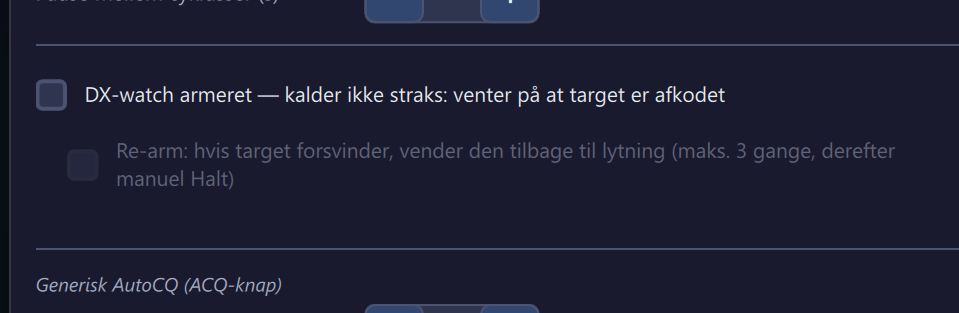
The autocall function has been active for many versions.
PD2WL
FT2-0154
2026-07-18 18:36:31 UTC
Yes, but that is the Auto CQ, it is different from the Autocall who automatic calling stations who made a CQ.
PD2WL
FT2-0154
2026-07-18 18:44:33 UTC
I can also not find the screen you posted in the Setup, but maybe I'am looking in the wrong direction. Trying to find in into the Setup/ Advanced and Setup/TX
PD2WL
FT2-0154
2026-07-18 18:51:11 UTC
I have it now under the Call button, but it is not what I mean. Here I need to put in a target callsign.
Into WSJT-Z the program looks at the new decoded CQ stations and pick up automatically for me the one who is the most distance, or the most stronges or whatever I choose.
So without putting a target callsign.
IU8LMC
FT2-0001
2026-07-19 00:01:27 UTC
DECODIUM 4.0 — Auto-Caller Target Selection
Feature: Automatic selection of a CQ station to call, without manual callsign entry.
Status: Draft spec
Owner: IU8LMC · Implementation: 9H1SR (C++17/Qt6)
1. Goal
Reproduce and extend the WSJT-Z behaviour: instead of typing a destination
callsign, the operator selects a rule. After each decode cycle DECODIUM scans
the freshly decoded CQ stations, scores them by that rule, picks the best one,
and hands the callsign to the existing call pipeline — which already fires the
QSO automatically once a target is set.
The only new logic is the chooser that produces the callsign. Nothing
downstream of "target is set" changes.
2. Selection criteria
Exposed as a dropdown. One active at a time (v1).
CriterionScore keyRequiresFarthestgreat-circle distance from own grid (max)caller locator*Strongest signalSNR in dB (max)always presentWeakest signalSNR in dB (min), still decodablealways presentNew DXCCstation in a not-yet-worked entityADIF logNew gridstation in a not-yet-worked grid (4-char)ADIF log + locNew callsigncallsign not present in logADIF logRandomuniform pick over the filtered pool—
* If the CQ frame carries no locator, fall back to a DXCC-prefix centroid, or
skip the candidate for distance-based rules (configurable: skip vs centroid).
3. Pipeline (per decode cycle)
Collect candidates: every station calling CQ this cycle.
Filter (drop candidate if any is true):
already worked per current dup rules (band/mode/entity as configured)
on blacklist
outside enabled band/mode
directed CQ that does not match own target (e.g. CQ EU, CQ DX) —
only when "respect directed CQ" is enabled
Score the survivors by the active criterion.
Tie-break (see §4).
Commit the winning callsign to the call pipeline and lock it (§5).
4. Tie-breaking
SNR ties are common. Use an ordered secondary key so the chooser never
deadlocks:
primary criterion → distance (desc) → random
5. QSO lock / persistence
Once a callsign is committed, hold it until the QSO completes or times
out. A stronger/closer station appearing mid-sequence must not pull the
operator off the current contact. On completion the lock releases and the
chooser resumes on the next cycle.
6. Timing (ASYMX)
With ~300 ms TX latency in ASYMX, scoring must run immediately on decode
completion, not on a separate timer — the target has to be committed before
the TX window opens. Treat the chooser as part of the decode-complete handler.
PD2WL
FT2-0154
2026-07-19 05:20:36 UTC
Thanks for explanation.
PD2WL
FT2-0154
2026-07-29 14:40:23 UTC
I tried everything now but still see no option to use any kind of "autocall" without giving a target.
Back to WSJT-Z for the time beïng now till we have the same autocall as over there.